The question
Given a target gene, exon, and tissue — and optionally a patient's VCF — which ASO candidate should a lab synthesize and test first, and why?
That is the only question PINNAL answers. You bring the target; PINNAL returns a ranked, audit-traceable shortlist of antisense-oligonucleotide candidates — each with its mechanism annotation, off-target risk flags, structural accessibility, and a machine-readable lab protocol. It is a candidate ranker, not a target-discovery tool; a de-novo proposer, not a literature index. Every ranking is provably traceable to the input features that drove it.
The field
Nucleic-acid therapeutics target the transcript, not the protein — the fastest-growing path to drugging the previously undruggable.
Antisense oligonucleotides and splice-switching oligos already work in the clinic. Nusinersen rescues SMN2 exon-7 inclusion in spinal muscular atrophy; milasen was designed and dosed for a single child. The science is proven. The bottleneck is selection: for any target gene, exon, and tissue there are 200–5,000 possible binding sites, each synthesis costs $5K–$50K, and the field still chooses which ~10 to make first by intuition, tiling, and a literature scan.
For N-of-1 and rare-variant cases the stakes are sharper — a patient's own VCF can change which candidate is right, and no off-the-shelf tool weighs all of it at once. PINNAL is built for exactly that decision.
The problem
ASO design still has a translation gap.
Patient-specific ASO development means stitching together many steps — variant interpretation, splice-mechanism review, sequence analysis, target-region selection, off-target screening, structure checks, manual candidate triage, and protocol prep — often across a different tool for each. The decision trail fragments, and candidate selection comes down to spreadsheets, expert judgment, and manual handoffs.
For individualized medicine that fragmentation matters. Every candidate tested consumes time, material, assay capacity, and patient-specific opportunity.
Where the money goes
Cost compounds at every gate
In ASO development, the candidates selected for the first experimental panel can strongly influence downstream cost.
As an illustrative planning model, per-candidate testing costs may rise from hundreds of dollars in early in-vitro screening to thousands in potency studies, tens of thousands in rodent tolerability work, and substantially higher amounts in advanced toxicology studies.
Illustrative ranges:
- In-vitro efficacy screen — ~$500 per candidate
- In-vitro potency or dose-response — ~$2,000 per candidate
- Mouse tolerability study — ~$15,000–$20,000 per candidate
- Rat tolerability study — ~$25,000–$30,000 per candidate
- Advanced nonclinical toxicology — up to ~$100,000+ per candidate, depending on study design
Pinnal helps move candidate triage upstream, before synthesis and expensive validation work. By computationally prioritizing ASO candidates first, research teams can focus wet-lab and animal-study resources on a smaller, more defensible shortlist rather than brute-force tiling across thousands of possible sequences.
What Pinnal does
Pinnal helps prioritize what to test next.
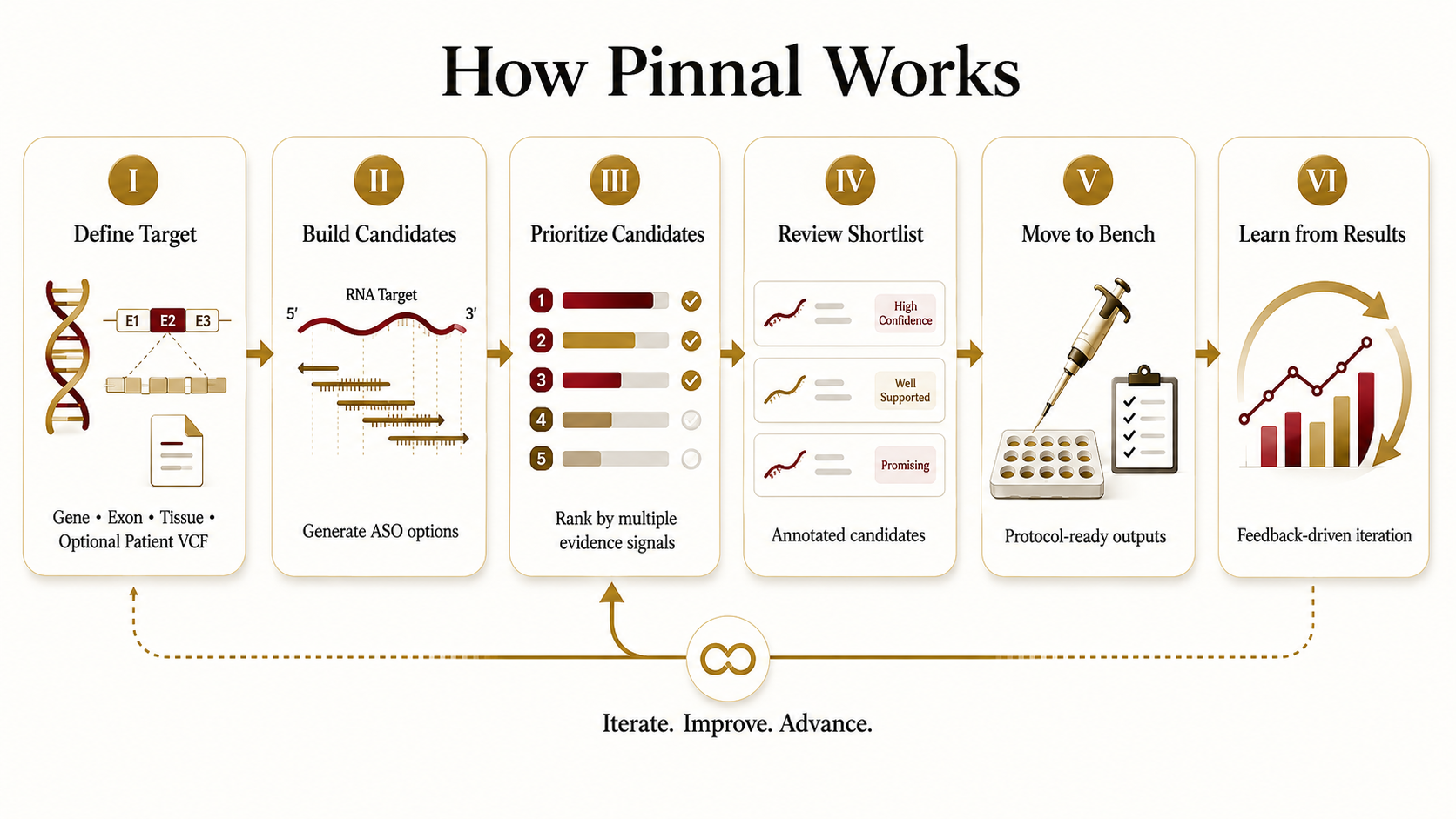
It combines target context, sequence-level features, splice-relevant signals, off-target risk flags, accessibility checks, and experimental feedback into a single ranked candidate shortlist — built for researchers and translational teams moving from a molecular hypothesis to a practical experimental plan.
- Identify candidate ASO binding regions around a target exon or splice-relevant locus.
- Rank candidates using multiple evidence signals rather than a single score.
- Review why each candidate was prioritized.
- Compare tradeoffs between predicted activity, specificity, accessibility, and confidence.
- Generate protocol-ready outputs for early wet-lab testing.
- Ingest experimental results to inform the next round of prioritization.
- Support N-of-1 workflows starting from a patient-specific variant file.
Designed for explainability
Not just a score — a decision trail.
ASO prioritization is rarely a single-variable problem; a candidate can look promising for one reason and risky for another. Pinnal makes those tradeoffs visible, comparing candidates across multiple dimensions and preserving an audit trail from input target to ranked output — easier to review, reproduce, and discuss across computational, bench, clinical, and translational teams.
Individualized medicine
Built for patient-specific ASO research.
For N-of-1 and rare-disease work, the key question is often whether a patient-specific variant creates a splice defect that an ASO can rescue. Pinnal lets teams include patient variant information during prioritization, then compare a general target run with a patient-specific run to surface candidates more relevant to that patient's molecular context.
Experimental feedback
The first experiment should inform the next one.
ASO development is iterative; the first screen rarely ends the story. Pinnal captures experimental results and uses them to support the next round of prioritization, moving teams from one-off candidate lists toward a learning workflow that improves with real experimental outcomes.
What Pinnal is not
Clear scope matters.
Pinnal is not a clinical diagnostic platform. It does not replace clinical genetic interpretation, ACMG review, RNA-seq confirmation, minigene assays, patient-cell validation, toxicology, GMP manufacturing, regulatory review, or clinical decision-making.
It is intended to support research-stage ASO prioritization and translational planning. Final candidate selection and clinical use require expert review and experimental validation.
Co-founder & Translational Strategy Lead
Preethi Ravindranathan
Preethi Ravindranathan brings experience across molecular biology, RNA biology, oncology drug discovery, biomarker research, and clinical research operations.
Her research background includes gastrointestinal cancer biomarker discovery, RNA-seq and non-coding RNA biology, androgen receptor signaling, peptidomimetic drug discovery, and RNA-targeted therapeutic strategies, including ASO and siRNA approaches to cancer-associated splice variants.
At UT Southwestern Medical Center, she was first author on a Nature Communications publication on peptidomimetic targeting of androgen receptor–coregulator interactions in prostate cancer, with related co-authored work in PNAS and Oncotarget.
At Murai Labs, Preethi leads Pinnal's clinical and translational strategy, helping connect computational ASO candidate prioritization with rare-disease workflows, experimental validation, and patient-specific research applications.
View LinkedIn profile
Collaborate
We are looking for early scientific collaborators.
Pinnal is being developed for researchers and translational teams working on splice-modifying ASOs, rare-disease mechanisms, and individualized medicine. We are especially interested in collaborations where computational prioritization can be paired with real experimental feedback.
Ideal collaboration areas
- Patient-specific splice-altering variants
- Pseudoexon or cryptic-exon rescue
- Exon inclusion or exon skipping programs
- Minigene or patient-cell assay systems
- Retrospective ASO screen datasets
- Transcriptome-wide off-target profiling
- Rare-disease N-of-1 workflows
What collaborators can expect
- A structured candidate-prioritization workflow
- Ranked ASO candidate shortlists
- Evidence-linked candidate review
- Protocol-ready outputs for early screening
- Support for feedback-driven iteration
- Transparent discussion of limitations and assumptions
All outputs are intended for research use and require expert review and experimental validation. Contact Murai Labs to discuss a target, dataset, or collaboration.
Related work
KALAVAI - Cooperative Specialist Fusion via Frozen-Layer MoE Routing.